Cherien Dabis Talks Palestinian Drama ‘All That’s Left Of You’: “Maybe We Have A Responsibility To Heal Our Trauma”

![Cherien Dabis [L] talks to Lana Komsany](https://storage.ghost.io/c/f6/3b/f63bba50-4e07-4fdb-a685-47f18f3c5b84/content/images/size/w1200/2025/12/Cherien-Dabis-panel.jpg)
Palestinian-American filmmaker Cherien Dabis shared her filmmaking journey and the logistics behind making her latest film, multi-generational family drama All That’s Left Of You, in the Souk Talks at Red Sea International Film Festival.
Set in the West Bank, the film follows a Palestinian family across three generations from the Nakba, the forced expulsion of Palestinians in 1948, to almost the present day in 2022, exploring how the socio-political events of these decades shaped the family’s experiences. The film premiered at this year Sundance Film Festival and has since picked up 25 awards on the festival circuit (including best film at Malaysia’s MIFFEST).
The film has also picked up a nomination at the Film Independent Spirit Awards and is Jordan’s entry for the Best International Feature category of the Oscars, with actors Mark Ruffalo and Javier Bardem supporting its campaign. Dabis also stars in the film, along with three members of the Bakri family of actors – Mohammad Bakri and his sons Adam and Saleh.
Speaking on the first day of RSIFF’s Souk Talks, Dabis said she’s had a strong desire since childhood to become a filmmaker, so she could tell authentic stories, an ambition that only increased when her family experienced racism during the Gulf War in 1990, when she was 13 years old.
“I was born and raised in the diaspora, in the United States, and raised really going back and forth between the US, Jordan and the West Bank,” Dabis explained. “So I got these windows into occupation, but I also had the experience of being a Palestinian living in the diaspora surrounded by Western media that was dangerously misrepresenting us and creating horrific stereotypes of us as Arabs, and as Muslims.”
She recounted that during the Gulf War, her father, a pediatrician who was highly respected in the community before that event, suddenly found himself the subject of racist abuse and with parents withdrawing their kids from his clinic. Adding an element of absurdity to the experience, the secret service visited her sister’s school because they’d heard claims that she had threatened to kill the President.
“Even as a child, I was aware that people didn't seem to like us, didn’t really know where Palestine was, or why Palestinians were fighting,” Dabis said. “And so, in this small town in Ohio, I thought why does nobody know our story? Why does nobody know how we became refugees, how we lost our country and our homeland? So for sure, this story was always in my mind – I wanted people to understand and know more about this.”
Attracted to storytelling from a young age, Dabis started out by taking acting and dancing classes and making family videos when her parents gave her a camcorder at the age of 12, despite their hopes that she would eventually become a lawyer. She also devoured the huge library of Egyptian films that her parents had brought to the US on VHS tapes: “I grew up watching these films, Egyptian movies from the ‘50s, ‘60s and ‘70s that were tackling taboos, and it was such a beautiful way of connecting with our culture.”
She then attended Columbia University to study filmmaking: “I was terrified that I didn’t have the talent but just thought that I have to do this”. She also felt she needed to undergo therapy so she could be more honest with herself: “I wanted to write honest things and not have to struggle with myself thinking, is it OK to say this? As a Palestinian, I have many layers of that, the taboo of like, how much can I tell of our story?”
Dabis directed two features before tackling All That’s Left Of You, both of which premiered at Sundance. She describes the first, Amreeka, as portraying the experience of being an Arab in America while her second, May In Summer, is about being an American in the Middle East. She has also written and/or directed a wide range of television, working on shows including Only Murders In The Building, Ramy, Ozark and The Sinner.
She had the idea for All That’s Left Of You in 2014, but decided to give it time to percolate, so spent a few years sketching out characters, storylines and researching the history. When the pandemic shut the world down in 2020 she felt it was finally time to start writing: “I thought let me just write this thing that's been in my head now for five years, and it just flowed out of me in a way that I've never experienced.”
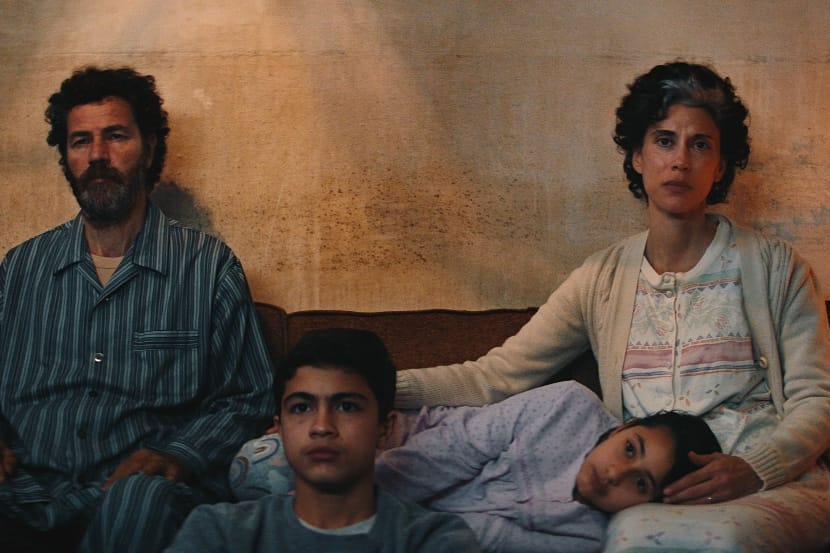
While the film is inspired by her relationship with her father, Dabis said she watched him become more angry and disullusioned about the situation in Palestine, to the point it affected his health, and decided that as a filmmaker she would try to be more hopeful. “If we talk about the trauma as a collective, we can attempt to heal it; then again it’s an ongoing situation, so perhaps it’s too late," Dabis said. "But those of us with privilege, we're not the ones living under occupation in these dangerous situations; maybe we have a responsibility to heal our trauma.”
Produced by Germany’s Pallas Film and Twenty Twenty Vision, Cyprus’ AMP Filmworks and co-producers in several countries, the film started prepping in Palestine in May 2023 with Dabis the only producer on the ground. The shoot was just two weeks away from commencing when the October 7 Hamas attacks on Israel forced the filmmakers to evacuate, leaving behind part of the cast and crew, along with five months of work.
“After five months of prepping in occupied territory, where we were going in and out of checkpoints, getting stopped and being interrogated, after all of that difficulty, we had to start all over again. It was really one of the most challenging things I've ever done,” said Dabis. “The other producers were very supportive and said we’ll do whatever you want to do. And I said, we have to keep going; this movie just became ten times more important, ten times more vital and urgent. Everyone who was working on the film felt that.”
The production first moved to Cyprus, where the crew had originally planned to shoot a small portion to take advantage of tax credits, and started prepping all over again. Dabis said there was always an intention to return to Palestine, that nobody thought the situation would just keep escalating, but eventually the production moved to Jordan: “At every stage, we were trying to get what we needed out of Palestine, our props, our costumes, our cast and crew, at a time when it was impossible to get anything out; embassies were closing; no-one wanted to give anyone a visa to leave.”
Among other tasks in the re-prepping process, the production built makeshift houses in a refugee camp in Jordan: “I’d done a lot of research; in Palestine, we visited a lot of refugee camps. I saw a lot of different layouts of apartments. We took a house that was basically falling apart, and constructed exactly what we were looking for, this house that was a bit of a labyrinth, because rooms would be added as the family expanded. It’s a very particular architecture.”
Dabis also had to recast one of the child actors in the film. “I’d already cast the role in Palestine, but I lost that actor. His family didn't want to be a part of a Nakba movie because they were scared. I was five days away from shooting and still hadn’t found the kid; so they made a wider casting call. Then I found that kid three days before shooting and he was amazing.”
All that’s Left Of You is one of three films submitted for the Best International Feature Oscar that portrays the Palestinian experience along with Annemarie Jacir’s Palestine 36, selected by Palestine, which is set during the British colonial period of the 1930s, and Tunisia’s entry, Kaouther Ben Hania’s The Voice Of Hind Rajab, based on the real-life story of the killing of a five-year-old Palestinian girl.
All three films are screening here at RSIFF – All That’s Left Of You in competition, Palestine 36 in Arab Spectacular and The Voice Of Hind Rajab as a Special Screening. The festival kicked off on December 4 with Rowan Athale's Giant, starring Amir El-Masry, and closes on December 13.