CJ ‘Fiery’ Obasi, Akuna & Durban FilmMart Execs On How African Cinema Is Evolving

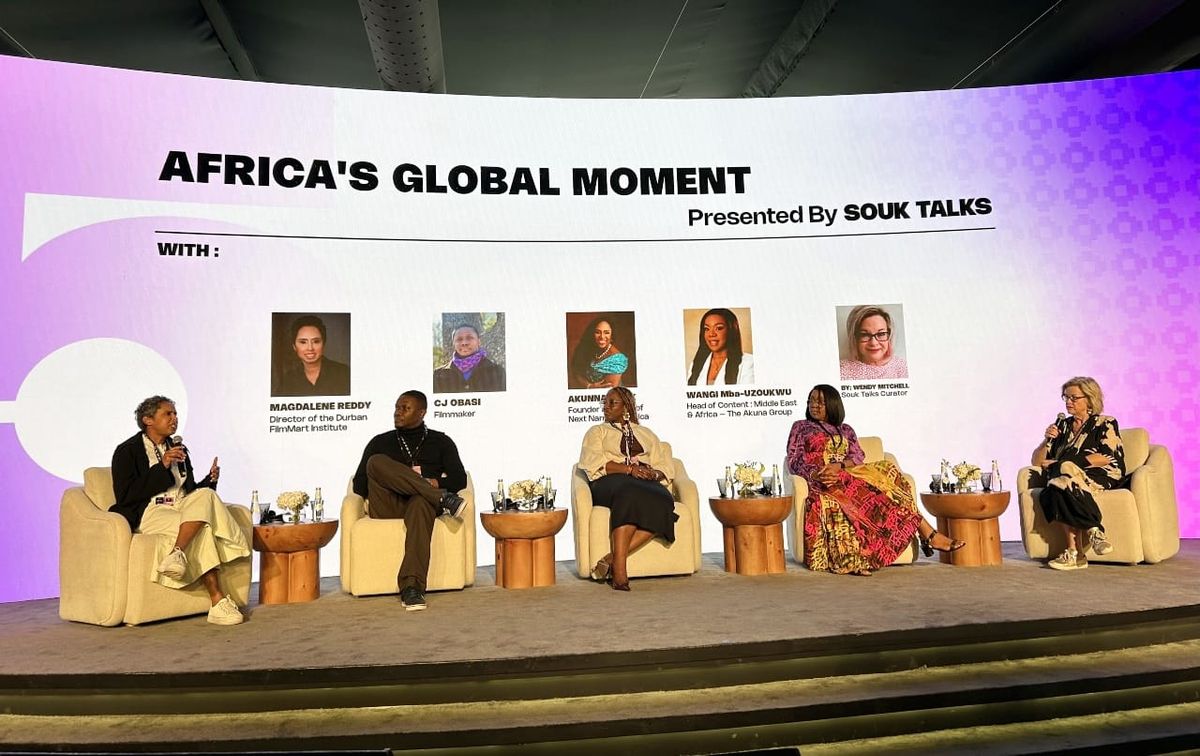
Industry execs and filmmakers, including Nigerian director-producer CJ ‘Fiery’ Obasi, discussed how African cinema is evolving through collaboration, as well as some of the challenges it faces, on a Souk Talks panel at Red Sea International Film Festival (RSIFF).
Also speaking on the panel were Durban FilmMart (DFM) director Magdalene Reddy; Wangi Mba-Uzoukwu, content chief at Idris Elba’s Akuna Group; and Akunna Cook, founder and CEO of Next Narrative Africa.
Among the topics discussed: attempts to bring private equity into the continent’s various film industries, so they can move beyond a grants and subsidies culture; issues with pan-African distribution, including a lack of cinemas and the recent reduction in content spending by the global streamers; and the need for new platforms and business models in the digital space.
Reddy talked about DFM’s projects market, labs and other initiatives that are encouraging collaboration between filmmakers in the African continent and other parts of the world. “The stories that African filmmakers are presenting to the world are so different, so diverse. In our training programmes, we really focus on how we tell our own stories in an authentic way.”
While agreeing that certain countries appear to be booming – South Africa, Nigeria, Kenya, Egypt and Morocco – Reddy also said that stories are emerging from all over the continent. Recent films to pass through DFM have included Disco Africa: A Malagasy Story from Madagascar and Goodbye Julia from Sudan. Two films screening at RSIFF – Kenyan filmmaker Zippy Nyaruri’s Truck Mama and The Settlement, from Egypt’s Mohamed Rashad – also participated in previous editions of DFM.
Cook, a former lawyer and political strategist, explained why she launched Next Narrative Africa – a production company and fund that aims to support African and Black Diaspora content creation: “I served as Deputy Assistant Secretary of State for Africa under the Biden administration and in that role really took to the creative industries because I understood how strategic media is, and especially pop culture, in shaping the way the world sees Africa.”
She also explained that the fund has two vehicles – one is grant-based, and will be announcing the first round of recipients in March 2026, while the other is equity-based, making investments in films, series and other forms of audiovisual content.
Eligible projects need to be at least 50% produced on the continent, tell a story that is “challenging the perception that the world has about Africa”, and also have some commercial value with a possibility to recoup. “At the end of the day, we want to prove that African cinema is not just about grants and niche arthouse film, but is actually an asset class,” Cook said.
Mba-Uzoukwu explained how Akuna Group is also investing in African stories, across films, series and digital content, and taking them to international markets. Launched by Elba earlier this year, the company has offices in Nigeria, Ghana, US and UK, and recently launched the Akuna Wallet in Ghana to help local creators get paid from anywhere in the world.
“In addition to financing content, we also want to partner with industry stakeholders to address distribution – bridging that gap between creators and audiences, platforms and markets,” Mba-Uzoukwu said.
Obasi, known for award-winning, highly-stylised fantasy thriller Mami Wata, talked about how he wants to diversify the kind of films made in Nigeria, which is known for the mainstream Nollywood industry, but not so much for arthouse cinema with global appeal.
“I’ve always felt like African cinema has been put in a box,” said Obasi, who is attending RSIFF with his work-in-progress La Pyramide. “Sure everyone knows Nollywood, and I love Nollywood, but Nigeria is a country of a 230 million people, so we can’t just have one offering.”
He noted international collaboration is one way to diversify. Mami Wata brought on board a Brazilian DoP, Lilis Soares, and was executive produced by Paris-based Francis Nebot and UK-based Iranian producer Abbas Nokhasteh. La Pyramide is also being produced by Nokhasteh as well as Colombian producer Andreas Borda Gonzalez.
Currently in post-production, La Pyramide is a supernatural story set in New Orleans in the US, Dakar in Senegal and Salvador in Brazil. “There’s an intrinsic connection, historically, culturally and even spiritually between these three places,” said Obasi. “We all know what happened with transatlantic slavery, but this film is not about that, it’s about the celebration and changing the definition of transatlantic slavery.”
The speakers also acknowledged the gaps in infrastructure on the continent – there are very few film funds or co-production treaties, although filmmakers are finding their own ways to work across borders. “At this year’s DFM we tried to bring in voices from South America, from Asia, to reflect the reality of where the world’s at,” said Reddy. “A lot of things are shifting and it's time the Global South, the Global Majority, starts working together.”
Distribution is another big infrastructure challenge with the speakers agreeing that Africa needs to develop its own digital distribution systems rather than rely on global conglomerates. African creators are already taking advantage of YouTube and other user-generated content platforms to distribute their work, but more could be done.
“We know the audience is young and smartphone ready, so there’s definitely an opportunity with streaming, but I don’t think we should wait for it to be built for us,” said Mba-Uzoukwu.
Cook added: “With the consolidation that is happening in Hollywood right now, the reality is that we may have shorter theatrical windows. Streaming is also going through a lot of changes, so it’s challenging to make the case to financiers that these projects are going to recoup.”
She agreed that the solution could partly lie in Africa building its own distribution networks, as well as thinking innovatively about delivering content to audiences and explaining to investors that there’s an untapped audience.
“They want to see representation, they want to see their stories out there, and we need to make the case that there’s an underserved audience. I’m not sure what that’s going to look like exactly, because none of us do, but we don’t necessarily have to tie our fates to legacy systems.”
Obasi said his experience with Mami Wata shows what’s possible – the film was sold to more than 35 territories and had a theatrical release in the UK and Japan. “One thing I learned through this process was just how awful the African distribution system is, with the weekend run in the UK bringing in more than the release in 12 African countries, which doesn’t make any sense to me.
“But we want to take what we learned and apply that to La Pyramide, because it’s a global story with African roots, and see how that translates if we push a little bit more,” Obasi continued “We’ve found there’s a hunger to see African stories, to see themselves in new ways, and not just the usual African narrative.”
Prompted by a question from the audience, the panellists also discussed the situation for diaspora filmmakers, especially in North America, who can’t tap African funds because they’re not based in the continent, but often also get excluded from financing in the countries where they’re based.
Cook responded: “We’ve intentionally designed our fund to promote collaboration between Africans on the continent and within the diaspora. One criteria is that half of the production needs to take place on the continent, but that’s because we want the other half to be able to take place in other parts of the world.”