JAFF Market: What Factors Are Holding Back Further Indonesian Box Office Growth?

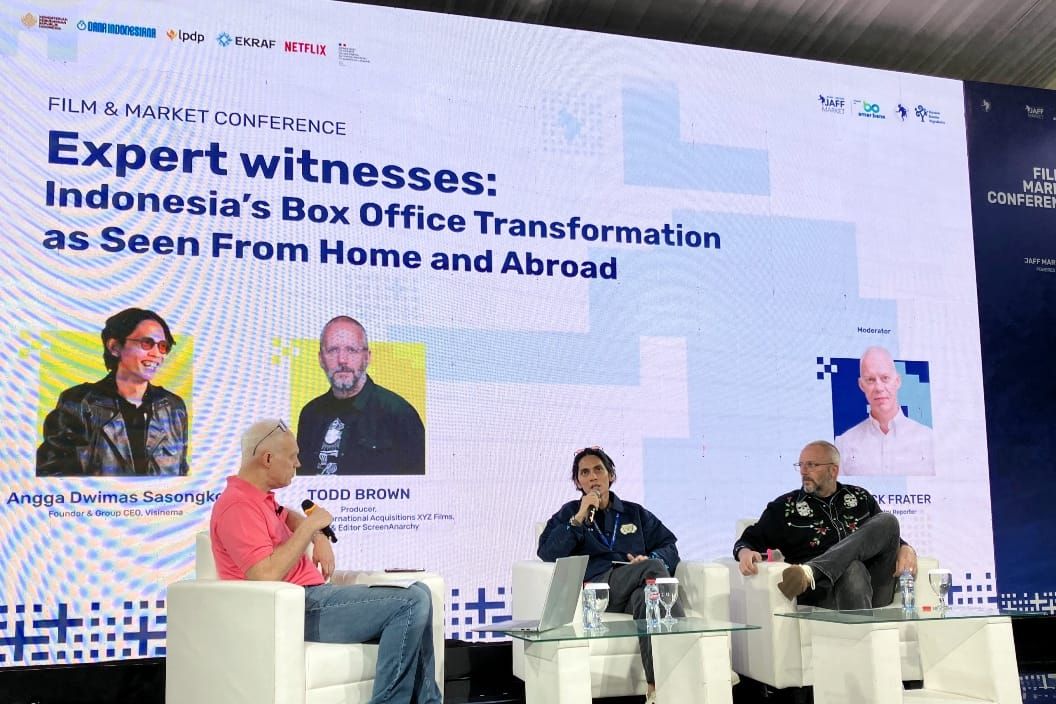
Indonesia’s box office has been relatively healthy since the pandemic, mostly driven by the success of local films, but speakers at JAFF Market discussed several factors that are slowing down further growth in the market.
At a panel entitled ‘Expert Witnesses: Indonesia’s Box Office Transformation as Seen From Home and Abroad’, Angga Dwimas Sasongko, CEO of Indonesian studio Visinema, and producer and Asian cinema expert Todd Brown, talked about the two biggest issues facing the market – the current over supply of horror movies and the lack of capital to build out cinema infrastructure.
Visinema was behind one of the most successful counter-programming moves this year – releasing family animation Jumbo over the Lebaran holiday against a glut of horror films. Jumbo went on to sell more than 10 million tickets and become the highest-grossing local film of all time.
“My belief is that if we want to make Visinema sustainable we can’t just depend on box office, because there’s a ceiling for that – we’re limited by the number of screens and seats available – and that’s not something in our control. So we need to find something new, perhaps producing different formats or targeting the international market,” Angga said.
Indonesia is severely under-screened with around 2,375 screens for a population of 280 million. Until recently there was only one big player, Cinema XXI, in the market, and while others have entered, expansion has been slow.
“It’s a lack of capital,” said Angga. “There are companies that have capabilities to go into this industry, but they refuse because there are problems with the market, to be honest, like the gap in spending power between Jakarta and other cities is very big. But we also have cities with a population of three million and only one cinema there.”
Brown noted that many countries around the world, including the whole continent of Africa, have this issue with lack of screens, but building cinemas requires massive capital investment at a time when consumers are moving to streaming, a technology that is cheaper and easier to roll out.
“Africa is dealing with this right now. There’s an entire continent of a billion under-serviced people and I don't know the exact number but probably between 500-750 screens in all of Sub-Saharan Africa. Are they ever going to become a cinema continent? Probably not, because by the time that infrastructure catches up, the entire young generation will have moved into other ways of accessing the material,” Brown said.
However, he also noted that Gen Z has been online and isolated their whole lives and are showing signs of moving back to communal experiences. “In the West at least, we’re seeing that Gen Z are a cinema-going audience in a way that Millennials never were.”
Angga noted that Indonesian consumers don’t have many options for communal entertainment: “We don’t have parks, we don’t have other places we can gather together, if it's not our own homes, we can bring our families to visit the cinemas and the malls.”
In terms of content, horror films have been driving box office in recent years, but Angga observed that three or four are opening every weekend and recently recoupment rates have been low. However, other genres including Jumbo and Imajinari’s sci-fi romance Sore: Wife From The Future have seen encouraging results.
“As Indonesian producers, we need to have more courage, to give more opportunities to new ideas, new voices that can connect with the audiences,” Angga said.
A separate panel on JAFF Market’s final day – ‘Elevating Cinema Business In The Competitive Screen Industry Landscape' – brought together speakers from Indonesia’s major exhibitors, studios and ticketing platforms to discuss the issue of cinema infrastructure further.
Suprayitno, head of government relations at Cinema XXI, cited high taxes and regional government regulations as some of the obstacles preventing further cinema expansion
Starvision CEO Chand Parwez Servia said there’s a need for more independent exhibitors, but that they also need access to new malls: “This industry needs more screens and that can’t be done by major studios and exhibitors only. We also need independent and alternative exhibitors, but the problem is that these cinemas can only survive where there are no major exhibitors. Perhaps the balance can be pricing.”
Sonu Samtani, president of independent exhibitor Sam’s Studio, which launched in 17 locations across Java just one year ago, said there’s real audience demand to see Indonesian movies on the big screen in regional areas: “We show Indonesian films both commercial and arthouse films in our cinemas. The most important thing is to provide access to entertainment for local audiences where cinemas don’t exist now.”