Kenyan Filmmaker Zippy Nyaruri On The Ten-Year Journey Behind Red Sea Competition Title ‘Truck Mama’

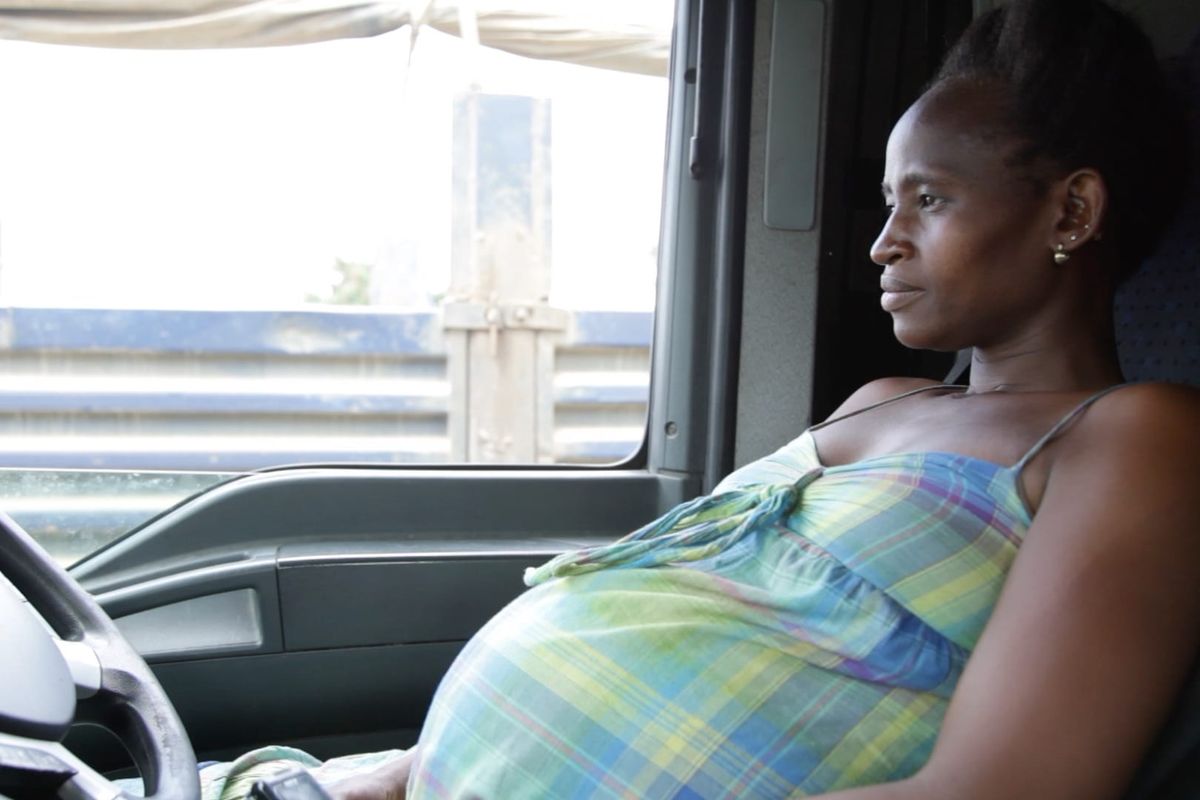
If you’ve ever struggled in your career as a woman in a man’s world, spare a thought for Evaline Wambua Mutuku, the subject of Zippy Nyaruri’s documentary Truck Mama, whose job used to involve driving articulated lorries across East Africa, sometimes into war-torn countries like South Sudan.
In Nyurari’s feature-length doc we see how Eva, through a combination of grit, humour and resilience, manages to navigate this male-dominated world from dealing with obstructive border guards to wrangling makeshift tools when her truck breaks down shortly after crossing the South Sudan border. As a single mother, she’s also juggling work with keeping an eye remotely on her two-year-old son and his worryingly laidback nanny.
The Swahili, English and Kikamba-language film is receiving its international premiere in competition at Red Sea International Film Festival (RSIFF) after world premiering at this year’s International Documentary Film Festival Amsterdam (IDFA).
Both Nyaruri and Eva are in Jeddah to present the film, which received rapturous applause and a lengthy Q&A after its screening. In addition to exploring the pressures that all working mothers have to face, it’s also an interesting portrait of how women handle themselves in an all-male environment. Speaking to Streamlined the day after the screening, Eva says she never felt threatened on the road, and it’s clear in the film that the male truck drivers she encounters respect her and are willing to help her.
But Nyaruri points out that its Eva’s personality that helps her navigate this space and makes an observation that many women will recognise: “She’s friendly with everyone, and that’s maybe her defense mechanism, so the ones who knew her were very protective; they took her in as their sister, their mother. But the ones who didn’t know her sometimes felt threatened or challenged that a woman was doing their job.”
Nyaruri says she started working on the film more than ten years ago. She had heard there were female truck drivers in Kenya and set out to meet one, but it took her a while to track down Eva: “When I finally called her, she said she was pregnant and thinking about giving up driving. We met anyway, she was in Mombasa at the time, and two years later we started this amazing journey.”
At the start of production, the film was funded by Docubox, a Nairobi-based fund that supports East African documentaries, which Nyaruri could access because she was still living in Kenya at the time. “They’ve really helped to raise up the East Africa filmmaking community, because when you’re in development and someone trusts your film, it helps build momentum to keep going forward,” Nyaruri says.
However, when she moved to the Netherlands, Nyaruri found that she fell through the cracks: “I couldn’t qualify for funds in Africa because I wasn’t living in Africa anymore; but I couldn’t qualify for European funds because I’ve already filmed,” she explains. “So we self-funded and picked up cultural grants here and there, you know the ones that are not limited by structure. It took quite a while, and I was also starting my new life in Europe, but I never stopped thinking about this project.”
After participating in Durban FilmMart, she met her South African co-producer, Portia Cele, and secured production funds from South Africa’s National Film and Video Foundation (NFVF), which helped with travel and visa costs while shooting in East Africa. Red Sea Fund supported post-production on the film.
Visas and border regulations turned out to be one of the biggest challenges when shooting the film. A fixer in South Sudan, who was supposed to organise permits and visas, never showed up, so Nyaruri had to leave two of her four-person crew in Uganda: “One of the crew was from the Netherlands so had a European passport. You’d think you could go many places with an EU passport, but you need a visa for South Sudan. I tried to look on the bright side – at least with a smaller crew we’d attract less attention.”
Truck Mama is Nyaruri’s first feature-length project. Starting her career as a business journalist, she moved into filmmaking “for the love of story” and participated in labs including IDFAcadmy, Circle Women Doc Accelerator and Berlinale Talent Campus. Her previous credits include Uganda-set short documentary Mama Emerre and short fiction film Zebu And The Photo Fish, which have screened as festivals including Durban, FESPACO and Toronto.
Now that the film is travelling to festivals, Nyaruri says she really hopes she can also show it to audiences in Kenya: “It’s so important to get our films watched, not just outside East Africa, especially a film like this which shows both the challenges but can also be inspirational.” She’s also working with other East African filmmakers as a producer.
As for Eva, she says she’s finally given up driving and is focusing on a business venture. While her oldest son is now 27, her youngest is 12 and needs more of her attention. In the meantime, her story looks set to keep travelling around the international festival circuit for some time to come.